AI-Powered Diabetic Retinopathy Screening: A Game Changer

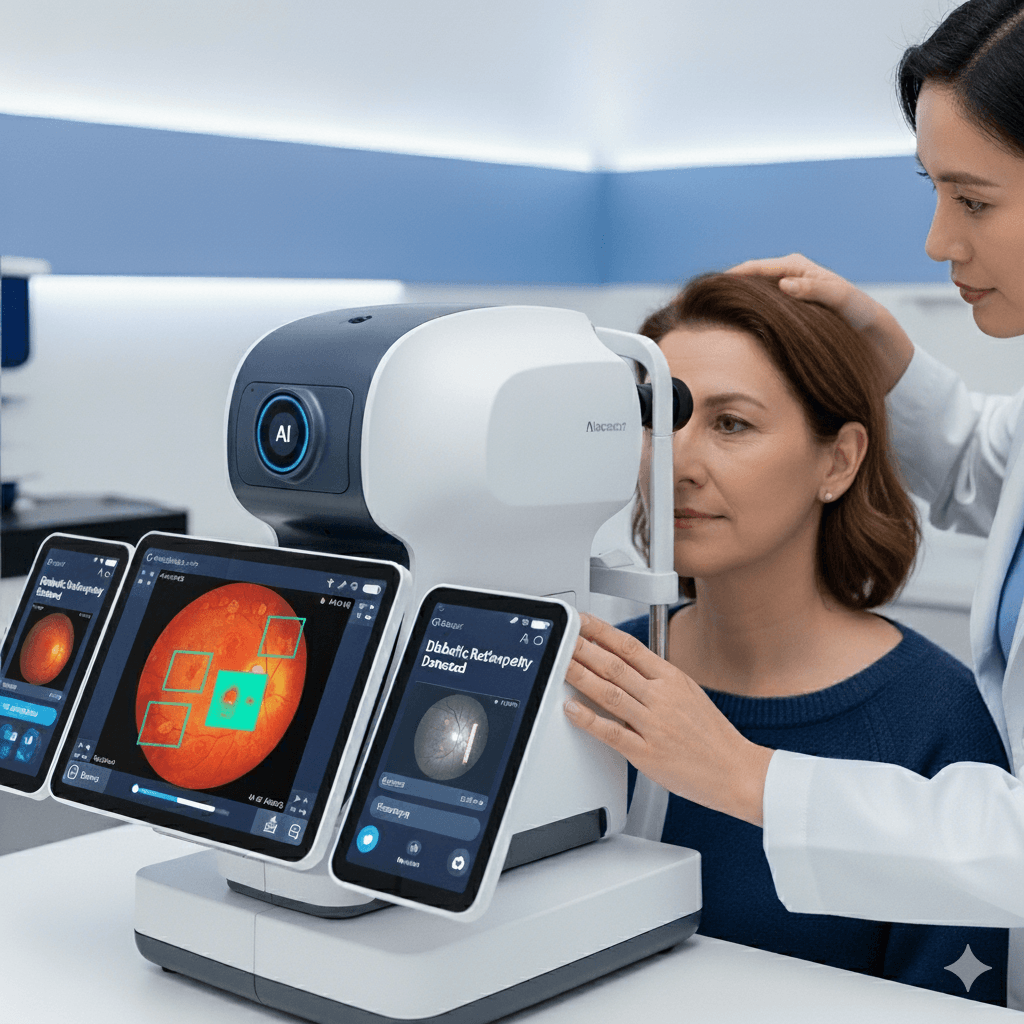
AI-Powered Diabetic Retinopathy Screening: A Game Changer
Diabetic retinopathy (DR) is a leading cause of vision loss among working-age adults, affecting an estimated 103 million people worldwide. Traditional screening methods are time-consuming and require specialized expertise, but AI is changing this landscape dramatically.
The AI Revolution in DR Screening:
• Automated Analysis: Deep learning algorithms can analyze retinal images with remarkable accuracy, detecting microaneurysms, hemorrhages, and neovascularization.
• Scalability: AI systems can process thousands of images per hour, making mass screening programs feasible in resource-limited settings.
• Consistency: Unlike human graders, AI provides consistent results regardless of fatigue or experience level.
• Early Detection: AI can identify subtle changes that might be missed by human observers, enabling earlier intervention.
Clinical Evidence:
Recent studies show AI systems achieving sensitivity rates of 95-98% and specificity rates of 90-95% for DR detection. The FDA has approved several AI-based diagnostic tools, including IDx-DR and Google Health's autonomous AI system.
Implementation Challenges:
• Integration: Seamlessly incorporating AI tools into existing clinical workflows.
• Training: Ensuring healthcare providers understand how to interpret AI results and when to seek human confirmation.
• Regulatory Compliance: Navigating FDA approval processes and maintaining patient privacy standards.
Real-World Impact:
In countries like Thailand and India, AI-powered screening programs have increased DR detection rates by 30-50%. These systems are particularly valuable in rural areas where ophthalmologists are scarce.
Retnovi's Approach
Our AI platform combines advanced deep learning with clinical expertise to provide:
• Multi-modal Analysis: Integrating OCT, fundus photography, and clinical data for comprehensive assessment.
• Explainable AI: Clear visualizations showing why the AI made specific recommendations.
• Continuous Learning: Systems that improve over time as they encounter more diverse patient populations.
Looking Ahead
As AI technology matures, we can expect even more sophisticated applications, including predictive analytics for DR progression and personalized treatment recommendations.
The key to success lies in thoughtful implementation that combines technological innovation with clinical wisdom. AI should enhance, not replace, the critical role of ophthalmologists in patient care.
How AI Transforms Traditional DR Screening
Before AI:
- Manual grading requiring trained specialists
- Time-consuming review of thousands of images
- Limited scalability in resource-constrained settings
- Variable accuracy depending on grader experience
With AI Transformation:
- 24/7 Automated Analysis: Instant processing of retinal images with consistent accuracy
- Population-Scale Screening: Ability to screen millions through telemedicine networks
- Earlier Detection: Identification of subtle changes missed by human observers
- Cost-Effective Monitoring: Regular screening becomes economically viable at scale
AI-Enhanced Patient Journey:
- Image Capture: Smartphone or portable device captures retinal photos
- Instant AI Analysis: Automated detection of DR severity and progression
- Risk Stratification: AI predicts which patients need urgent specialist care
- Treatment Optimization: AI guides personalized treatment protocols
Resources
For more information about diabetic retinopathy, visit the American Academy of Ophthalmology or the National Eye Institute.
Contact Us
Ready to explore how AI can transform diabetic retinopathy screening in your practice? Reach out to us at support@retnovi.ai.